Kategori
Blog baru.
Apa Keunggulan Tepat Kipas EC Dibandingkan Motor AC Tradisional dalam Sistem HVAC?
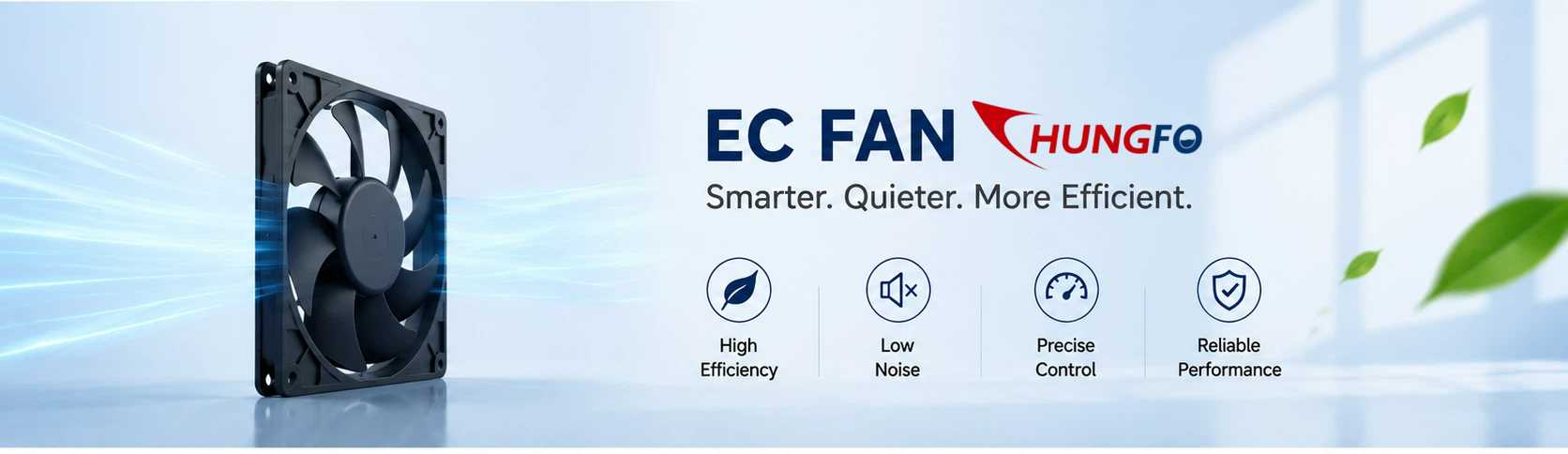
August 28 , 2026Industri HVAC terus bergerak menuju efisiensi yang lebih tinggi, kontrol yang lebih cerdas, pengoperasian yang lebih tenang, dan desain sistem yang lebih fleksibel. Di antara teknologi yang mendorong perubahan ini, kipas yang dikendalikan secara elektronik, yang biasa disebutPenggemar EC, telah menjadi semakin penting dalam unit penanganan udara, unit koil kipas, sistem ventilasi, peralatan pendingin, pompa panas, unit atap, dan aplikasi pergerakan udara lainnya.
Selama beberapa dekade, motor AC tradisional, terutama motor kapasitor split permanen dan desain motor induksi lainnya, banyak digunakan dalam peralatan HVAC karena relatif sederhana, andal, familiar bagi produsen, dan mudah didapatkan. Namun, sistem HVAC modern jarang beroperasi pada satu beban tetap sepanjang waktu. Permintaan pendinginan dan pemanasan berubah sepanjang hari, suhu luar ruangan berfluktuasi, tingkat hunian berubah, filter menjadi penuh, dan sistem otomatisasi bangunan terus menerus menyesuaikan kebutuhan aliran udara.
Di sinilah teknologi kipas EC menciptakan keunggulan utama.
Kipas EC menggabungkan motor yang dikendalikan secara elektronik dengan kontrol elektronik terintegrasi. Meskipun biasanya dapat dihubungkan ke catu daya AC, pengoperasian motor internalnya menggunakan komutasi elektronik dan teknologi magnet permanen. Hal ini memungkinkan kipas beroperasi secara efisien pada kecepatan yang berbeda sambil menerima sinyal kontrol yang presisi.
Menurut ASHRAE, motor yang dikendalikan secara elektronik (EC) memberikan kemampuan kontrol yang lebih unggul dan dapat merespons sinyal kontrol lokal atau jarak jauh, termasuk sinyal dari sistem manajemen gedung. ASHRAE juga mencatat bahwa motor EC dapat memberikan penghematan energi yang signifikan dibandingkan dengan motor PSC konvensional, terutama dalam kondisi beban parsial.
Oleh karena itu, keunggulan sebenarnya dari teknologi EC bukan hanya terletak pada konsumsi listrik motor yang lebih rendah pada satu titik operasi. Keunggulan yang lebih besar adalah bahwa seluruh sistem kipas dapat merespons kebutuhan termal dan aliran udara aktual dari peralatan HVAC.
Memahami Perbedaan Antara Kipas EC dan Motor AC Tradisional
Sebelum membandingkan keunggulannya, penting untuk memahami apa sebenarnya perbedaan antara kedua teknologi tersebut.
Motor induksi AC atau PSC tradisional menerima arus bolak-balik dan menciptakan medan magnet berputar yang menggerakkan rotor. Karakteristik operasinya sebagian besar ditentukan oleh frekuensi suplai, konstruksi motor, beban, dan metode kontrol. Jika operasi kecepatan variabel diperlukan, peralatan kontrol tambahan seperti penggerak frekuensi variabel mungkin diperlukan untuk banyak konfigurasi motor AC.
Motor PSC tradisional dapat menjadi pilihan praktis untuk peralatan HVAC sederhana yang hanya membutuhkan pengoperasian hidup dan mati dasar atau sejumlah kecil tingkat kecepatan tetap. Motor ini telah banyak digunakan dalam unit fan coil, pendingin udara, sistem ventilasi, dan peralatan lainnya.
Motor EC, sebagai perbandingan, berisi rangkaian komutasi elektronik dan magnet permanen. Pengontrol elektronik menentukan kapan dan bagaimana arus dialirkan ke kumparan motor. Hal ini memungkinkan kecepatan motor disesuaikan secara elektronik, bukan hanya bergantung pada karakteristik suplai AC.
Hasilnya adalah rakitan motor dan kipas yang dapat beroperasi pada rentang kecepatan yang jauh lebih luas.
Perbedaan ini menjadi sangat penting dalam sistem HVAC karena kebutuhan aliran udara jarang sekali konstan.
Suatu bangunan mungkin membutuhkan aliran udara maksimum pada siang hari yang panas ketika tingkat hunian tinggi, tetapi hanya sebagian kecil dari aliran udara tersebut pada pagi hari, malam hari, atau cuaca yang sejuk. Sistem kecepatan tetap konvensional mungkin terus beroperasi pada kecepatan tinggi dan kemudian menggunakan siklus, peredam, atau metode lain untuk mengurangi aliran udara efektif.
Kipas EC justru dapat mengurangi kecepatannya secara langsung.
Perubahan yang tampaknya sederhana itu dapat berdampak signifikan pada total konsumsi energi.
Keunggulan Utama Pertama: Konsumsi Energi Lebih Rendah
Alasan terpenting mengapa produsen dan insinyur HVAC mempertimbangkan kipas EC adalah efisiensi energi.
Energi kipas sangat dipengaruhi oleh kecepatan. Untuk banyak sistem kipas yang beroperasi dalam kondisi yang sebanding, mengurangi kecepatan kipas dapat menghasilkan pengurangan daya poros yang dibutuhkan secara tidak proporsional. ASHRAE menjelaskan bahwa daya poros kipas bervariasi kira-kira sebanding dengan pangkat tiga kecepatan dalam kondisi hukum afinitas. Ini berarti bahwa pengurangan kecepatan yang relatif kecil dapat menghasilkan pengurangan daya kipas yang jauh lebih besar.
Sebagai contoh, jika kipas HVAC dapat mengurangi kecepatannya hingga sekitar 80 persen dari kecepatan penuh, kebutuhan daya kipas secara teoritis dapat turun menjadi sekitar 51 persen dari nilai semula dalam kondisi hukum afinitas yang sesuai.
Pada kecepatan sekitar 70 persen, kebutuhan daya teoritis dapat turun hingga sekitar 34 persen.
Pada kecepatan sekitar 50 persen, angka tersebut dapat turun hingga sekitar 13 persen.
Angka-angka ini bersifat teoritis dan kinerja HVAC aktual bergantung pada kurva kipas, resistansi sistem, efisiensi motor, metode kontrol, persyaratan tekanan, dan titik operasi. Meskipun demikian, angka-angka ini menunjukkan mengapa pengoperasian kipas kecepatan variabel bisa sangat ampuh.
Inilah salah satu perbedaan terpenting antara kipas EC dan motor AC kecepatan tetap tradisional.
Motor konvensional mungkin harus beroperasi pada kecepatan yang relatif tinggi dan menggunakan metode mekanis atau listrik untuk membatasi aliran udara. Kipas EC dapat langsung mengurangi kecepatan motor sehingga kipas hanya menghasilkan aliran udara yang dibutuhkan oleh sistem.
Hasilnya adalah berkurangnya energi yang terbuang.
ASHRAE secara khusus mengidentifikasi kinerja beban parsial yang kuat dari motor EC sebagai salah satu keunggulan utamanya. Pada unit terminal bertenaga kipas, ASHRAE melaporkan bahwa motor EC dapat menggunakan energi yang jauh lebih sedikit daripada motor PSC pada aliran udara desain tipikal, dengan keunggulan yang lebih besar lagi dimungkinkan pada aliran udara yang lebih rendah.
Hal ini penting karena sistem HVAC menghabiskan sebagian besar waktu operasinya di luar beban puncak.
Sistem yang dirancang untuk hari terpanas dalam setahun tidak beroperasi pada kebutuhan pendinginan maksimum setiap jam sepanjang tahun. Oleh karena itu, mengevaluasi efisiensi motor hanya pada beban penuh dapat memberikan gambaran yang tidak lengkap tentang konsumsi energi tahunan.
Pertanyaan yang lebih tepat bukanlah sekadar, “Motor mana yang memiliki efisiensi tertinggi?”
Pertanyaan yang lebih tepat adalah, “Seberapa efisien kipas beroperasi di seluruh profil beban tahunan?”
Di sinilah teknologi EC menjadi sangat menarik.
Keunggulan Tepat Kedua: Efisiensi Beban Parsial yang Sangat Baik
Pengoperasian beban parsial adalah salah satu argumen terkuat untuk mengganti motor kipas AC konvensional dengan teknologi EC.
Sistem HVAC seringkali berukuran terlalu besar dibandingkan dengan beban sesaat karena peralatan harus mampu menangani kondisi puncak. Penelitian ASHRAE tentang unit fan coil menjelaskan bahwa sistem ini jarang beroperasi pada beban penuh untuk jangka waktu yang lama, sehingga modulasi menjadi peluang penting untuk mengurangi konsumsi energi.
Motor tradisional seringkali bekerja efisien dalam rentang operasi yang lebih sempit. Ketika aliran udara perlu dikurangi, sistem konvensional dapat menghidupkan dan mematikan motor secara bergantian atau menggunakan sejumlah pengaturan kecepatan yang terbatas.
Hal ini dapat menyebabkan konsumsi energi yang tidak perlu.
Kipas EC dapat menyesuaikan kecepatannya secara terus menerus.
Misalkan sebuah unit fan coil membutuhkan aliran udara 100 persen selama periode pendinginan puncak. Kemudian, beban termal menurun dan sistem hanya membutuhkan aliran udara 60 persen. Alih-alih terus beroperasi dengan kecepatan penuh dan berulang kali mati, kipas EC dapat mengurangi kecepatan dan mempertahankan aliran udara yang lebih rendah.
Hal ini meningkatkan efisiensi energi dan pengendalian suhu.
Laju aliran udara yang lebih rendah juga dapat mengurangi perpindahan panas yang tidak perlu dan membantu sistem HVAC beroperasi lebih dekat dengan kebutuhan termal yang sebenarnya.
Penelitian yang terkait dengan ASHRAE RP-1741 menemukan bahwa kontrol modulasi dapat secara signifikan mengurangi energi kipas dibandingkan dengan strategi siklus konvensional, dan simulasi energi bangunan menunjukkan bahwa penghematan sistem HVAC dapat substansial ketika aliran udara dan aliran air disesuaikan sesuai dengan beban.
Hal ini sangat relevan dengan bangunan komersial modern di mana beban HVAC terus berubah.
Keunggulan Tepat Ketiga: Kontrol Aliran Udara yang Lebih Akurat
Pengendalian aliran udara bukan sekadar masalah energi.
Hal ini secara langsung memengaruhi suhu, kelembapan, kualitas udara dalam ruangan, keseimbangan tekanan, dan kenyamanan penghuni.
Traditional AC motors may provide a simple high, medium, and low speed arrangement. This can work, but it limits the number of available operating points.
An EC fan can support much more precise speed control.
Depending on the model and control architecture, EC fans can accept analog or digital control signals and can be integrated with building automation systems. ASHRAE describes EC motors as devices that can respond to local or remote control signals and can support dynamic airflow control.
For example, a building management system can determine that a particular zone requires less cooling and send a lower speed command to the fan.
The fan responds immediately.
When the load increases, the speed can increase.
This creates a much closer relationship between actual building demand and fan output.
For modern HVAC equipment, that relationship is extremely valuable.
Exact Advantage Four: Better Compatibility With Smart HVAC Systems
Modern HVAC equipment is becoming increasingly connected.
Building automation systems can monitor temperature, humidity, pressure, occupancy, air quality, energy consumption, and other parameters. The HVAC system can then adjust operation according to those conditions.
An EC fan fits naturally into this architecture because the motor controller is already electronic.
Traditional AC motors can also be controlled electronically, but additional components may be required depending on the motor type and control strategy. This can increase system complexity.
An EC fan can integrate speed control directly into the fan motor assembly.
This creates a cleaner system architecture.
It can also reduce the amount of external control hardware required.
For HVAC manufacturers, this can simplify wiring and system integration.
For building operators, it can provide more flexible control.
For engineers, it can make it easier to develop demand-based airflow strategies.
The advantage becomes even more important when multiple fans are installed in a large HVAC system.
Instead of treating every fan as a simple fixed-speed device, the control system can coordinate fan speed with system demand.
Exact Advantage Five: Lower Noise During Reduced Load Operation
Noise is another major consideration in HVAC applications.
A fan operating at high speed generates more aerodynamic noise and motor-related noise than the same fan operating at a lower speed.
Traditional HVAC systems may need to operate a fan at a relatively high fixed speed and use cycling or other methods to manage demand.
An EC fan can reduce its speed when maximum airflow is unnecessary.
Lower speed generally means lower aerodynamic noise, although the exact noise reduction depends on fan geometry, air pressure, turbulence, mounting, duct design, bearings, and motor construction.
This is particularly useful in environments where acoustic comfort matters.
Examples include offices, hotels, hospitals, laboratories, residential buildings, classrooms, libraries, and commercial spaces.
A quieter HVAC system does not simply make the building more comfortable.
It can also improve the perceived quality of the HVAC equipment.
For manufacturers, this creates an opportunity to develop products that combine efficient airflow with low acoustic output.
Exact Advantage Six: Reduced Motor Heat
Motor efficiency is not only about electricity consumption.
Electrical losses become heat.
When a motor is less efficient, more of the input electrical energy is converted into unwanted heat. In HVAC equipment, that heat can become part of the thermal load that the system must manage.
ASHRAE notes that PSC motor inefficiency can manifest as motor heat added to the supply air. In some fan-powered terminal applications, this can increase the air temperature and reduce overall system efficiency.
EC motors can reduce this unwanted heat generation because of their higher efficiency and better part-load characteristics.
This is particularly useful in compact HVAC equipment where components are installed close together.
Lower internal heat can contribute to improved thermal conditions for nearby electronics and other components.
For compact air handling equipment, refrigeration systems, and integrated ventilation products, every reduction in unnecessary heat can be valuable.
Exact Advantage Seven: Compact And Integrated System Design
EC fans are often designed as integrated motor and fan assemblies.
The motor, controller, and impeller can be engineered as one system.
This is different from many traditional arrangements where the motor, control equipment, and fan are separate components.
An integrated EC design can reduce the need for external speed-control hardware and simplify installation.
It can also make the complete assembly more compact.
For equipment manufacturers, compactness can be important because modern HVAC products are often designed around strict dimensional requirements.
A smaller control footprint can create more room for heat exchangers, filters, insulation, electronics, or airflow passages.
This is especially valuable in packaged HVAC systems where internal space is limited.
Exact Advantage Eight: Easier Variable-Speed Retrofit Potential
Replacing an old AC motor is not always as simple as removing one motor and installing an EC fan.
The airflow requirement, static pressure, mounting dimensions, electrical supply, control signal, fan curve, and operating environment must all be considered.
However, EC technology can be attractive for retrofit projects because an integrated variable-speed fan can potentially replace a conventional fixed-speed fan assembly without requiring a completely new HVAC system.
The retrofit must be engineered carefully.
The replacement fan needs to deliver the required airflow and static pressure.
The electrical characteristics must be compatible with the equipment.
The control signal must be compatible with the existing controller or a suitable interface must be added.
The physical dimensions must fit the available installation space.
The result should be evaluated based on annual energy consumption rather than simply motor nameplate power.
This is particularly important because the greatest EC advantage often appears when the HVAC equipment spends significant time at part load.
Exact Advantage Nine: Better System Efficiency Than Simple Airflow Throttling
A common traditional strategy is to keep a fan running at a relatively high speed and then reduce effective airflow through dampers or other restrictions.
This approach can waste energy because the motor continues producing pressure that the system does not actually need.
EC technology takes a different approach.
Instead of forcing the fan to produce unnecessary pressure and then restricting the airflow, the control system can reduce the fan speed.
This allows the fan to operate closer to the required operating point.
The principle is simple.
Do not generate airflow that the building does not need.
Do not generate pressure that the system does not require.
Do not consume electrical power simply to overcome an unnecessary restriction.
The same philosophy can be applied to ventilation systems, air handling units, fan coil units, refrigeration equipment, and many other applications.
Exact Advantage Ten: Better Temperature And Humidity Management
HVAC control is not only about reaching a temperature setpoint.
Humidity and thermal stability are also important.
A fixed-speed fan can create larger changes between full-load operation and off periods. An EC fan with appropriate control can operate at a lower continuous airflow when the load is reduced.
This can help maintain a more stable indoor environment.
ASHRAE describes fully modulating EC fan coil systems as capable of varying fan speed according to control signals, with potential benefits for temperature and humidity stability as well as energy consumption.
This does not mean that every EC fan automatically provides perfect humidity control.
System design still matters.
The fan, coil, valve, controller, sensor, duct system, and building load must work together.
However, the EC motor provides the control capability required for much more sophisticated HVAC operation.
Why An EC Fan Can Be Better For Modern Air Handling Units
Air handling units often experience continuously changing operating conditions.
Outdoor air requirements change.
Filter pressure changes.
Building occupancy changes.
Cooling and heating loads change.
Static pressure changes.
A traditional fixed-speed AC motor can operate reliably under these conditions, but it does not inherently respond intelligently to them.
An EC fan can.
A controller can increase speed when airflow demand rises and reduce speed when demand falls.
The result is a fan system that behaves more like an active component of the HVAC control strategy rather than a simple motor that is switched on and off.
This distinction is increasingly important as commercial buildings become more automated.
Why EC Technology Is Valuable In Fan Coil Units
Fan coil units are another important application.
Traditional fan coil units often use three-speed motors.
The user or thermostat selects low, medium, or high speed.
This arrangement is simple, but the system only has a limited number of operating points.
Modern EC fan coil units can provide multiple speed levels or continuous modulation.
ASHRAE identifies EC motors as an increasingly common option for fan coil units and notes their advantages in energy efficiency, controllability, operating range, and comfort.
For hotels and offices, this can be particularly useful because room loads can vary significantly.
For example, a hotel room may have very different cooling requirements when occupied compared with when it is empty.
A variable-speed EC fan can respond to this difference.
The system does not have to operate as though the room is always at peak load.
EC Fans In Ventilation And Exhaust Applications
EC technology is not limited to cooling systems.
It can also be applied to ventilation, exhaust, air circulation, and fresh-air systems.
A ventilation system may need maximum airflow during occupied periods and reduced airflow at other times.
With an EC fan, the system can adjust airflow based on demand.
This can be useful in commercial buildings, industrial facilities, laboratories, kitchens, parking areas, and other ventilation environments.
The exact fan type depends on the required airflow and pressure.
For applications requiring direct airflow through a relatively open path, an Axial Fan can be an effective choice.
For applications requiring higher pressure or airflow through filters, coils, ducts, and compact passages, a centrifugal fan or blower may be more appropriate.
The key point is that EC motor technology can be integrated with different fan geometries.
This means engineers should not think of EC technology as a single fan shape.
It is a motor and control architecture that can be combined with the fan design required by the application.
EC Technology For Compact HVAC And Electronic Cooling
The demand for smaller HVAC and thermal management systems is also increasing.
Compact equipment requires smaller motors and fans that can deliver stable airflow without consuming excessive energy.
In these applications, anac dc small fanmay provide a useful solution when compact size, electrical flexibility, and controlled airflow are important.
Small EC or electronically controlled fan assemblies can be used in compact ventilation systems, control cabinets, refrigeration equipment, heat pump electronics, communication equipment, and other thermal management systems.
The same engineering principle remains important.
The fan should be selected according to airflow, static pressure, voltage, speed, noise, operating temperature, expected lifetime, and control requirements.
A small fan that consumes little electricity but cannot overcome the system resistance is not an efficient solution.
Fan performance must always be evaluated at the actual operating point.
EC Fans And Specialized Cooling Applications
Modern product development also creates demand for customized cooling components.
For example, rapid prototyping and customized equipment development can involve3d print cooling fansolutions where airflow is needed to control temperatures around printed parts, electronic modules, motors, or compact equipment.
Although the exact fan selection depends on the application, EC fan technology can provide advantages when the cooling requirement changes during operation.
The ability to adjust speed allows designers to avoid using maximum airflow continuously.
This can reduce noise and energy consumption while maintaining the required thermal conditions.
The same concept can be extended beyond additive manufacturing to laboratory equipment, automation systems, robotics, battery systems, and electronic enclosures.
EC Fan Selection: What Engineers Should Actually Compare
It is easy to compare an EC fan and an AC motor based only on motor efficiency.
That is not enough.
A professional comparison should include the complete fan system.
The first parameter is airflow.
How much air must the fan move?
The second parameter is static pressure.
What resistance must the fan overcome?
The third parameter is operating time.
How many hours per year will the fan operate?
The fourth parameter is load profile.
Will the fan operate continuously at full speed, or will it spend much of its time at partial load?
The fifth parameter is control method.
Does the system require on and off operation, three fixed speeds, or continuous variable-speed control?
The sixth parameter is acoustic performance.
Is the HVAC equipment installed in a residential, office, hospital, hotel, laboratory, or industrial environment?
The seventh parameter is electrical compatibility.
What voltage and control signals are available?
The eighth parameter is environmental performance.
Will the fan operate in high humidity, high temperature, dusty environments, or other demanding conditions?
The ninth parameter is mechanical compatibility.
Does the fan fit the existing mounting arrangement?
The tenth parameter is lifecycle cost.
The cheapest motor at purchase may not be the cheapest solution over ten years.
Purchase Price Versus Total Cost Of Ownership
One reason traditional AC motors remain popular is initial cost.
They are familiar products with established supply chains.
EC fan assemblies may have a higher initial purchase price because they include electronic controls and more sophisticated motor technology.
However, purchase price is only one part of the economic equation.
HVAC equipment may operate thousands of hours per year.
Even a modest reduction in power consumption can accumulate into significant annual savings.
If the fan operates continuously, the difference becomes even more important.
This is why EC fan selection should be based on lifecycle economics.
Engineers should compare annual kilowatt-hours, expected operating hours, maintenance requirements, replacement costs, and control requirements.
A higher initial investment can make sense when the annual operating savings and system benefits are sufficiently large.
When Traditional AC Motors May Still Make Sense
EC technology has many advantages, but it does not mean that traditional AC motors are always wrong.
A simple AC motor may still be suitable for applications with very low operating hours, simple on and off control, limited speed requirements, strict initial-cost targets, or existing infrastructure designed specifically around conventional motors.
For some large industrial systems, a conventional motor combined with a properly selected variable frequency drive can also provide excellent efficiency and speed control.
The decision should therefore be based on the actual application rather than technology preference alone.
A good engineering decision compares the complete system.
EC Versus AC: The Most Important Practical Difference
If the comparison has to be reduced to one sentence, the biggest difference is this:
A traditional AC motor is often treated primarily as a power source for the fan, while an EC fan can function as an integrated airflow control system.
That difference affects almost everything else.
Because the EC fan can vary speed, it can reduce energy consumption.
Because it can respond to control signals, it can improve airflow regulation.
Because it can operate at lower speeds, it can reduce noise.
Because its controller is integrated, it can simplify system architecture.
Because it can match output to load, it can improve part-load performance.
Because it can communicate with modern control systems, it can support smart HVAC applications.
This is why EC technology has become increasingly relevant to modern HVAC engineering.
The Role Of Fan Manufacturers In EC HVAC Development
Choosing the right motor technology is only part of the process.
The fan itself must also be designed correctly.
An efficient motor connected to an inefficient impeller will not automatically create an efficient HVAC system.
The impeller geometry, housing design, airflow path, motor characteristics, bearing system, balancing accuracy, vibration performance, acoustic design, and control algorithm all influence the final result.
For this reason, experienced fan manufacturers need to evaluate the complete fan assembly.
Chungfo Fan focuses on fan and motor technologies for different thermal management and air movement applications. For HVAC-related products, the engineering process should begin with the actual application requirements rather than simply selecting a motor from a catalog.
The required airflow, static pressure, voltage, speed, noise level, installation dimensions, control method, operating temperature, and expected service life should all be considered.
A properly selected fan can help HVAC manufacturers achieve a better balance between efficiency, acoustic performance, reliability, and system cost.

Why EC Fans Are Becoming A Strategic HVAC Choice
The HVAC industry is changing from simple fixed-speed operation toward intelligent load matching.
Buildings are becoming more automated.
Energy efficiency requirements are becoming more demanding.
Occupants expect better acoustic comfort.
Equipment is becoming more compact.
Maintenance and lifecycle costs are receiving more attention.
These trends all favor technologies that can adapt to changing conditions.
EC fans fit this direction very well.
They are not simply a replacement for a traditional AC motor.
They represent a different approach to fan system design.
Instead of generating a fixed amount of airflow and controlling the result through cycling or restriction, an EC fan can adjust its output directly.
This is a fundamental reason why EC technology can provide strong advantages in modern HVAC systems.
Final Conclusion
The exact advantages of EC fans over traditional AC motors in HVAC systems can be summarized through several connected benefits.
EC fans can provide higher efficiency, especially during part-load operation. They can provide continuous or flexible speed control, respond to temperature and airflow requirements, reduce unnecessary fan power, lower operating noise at reduced speed, reduce motor heat, simplify electronic integration, and support modern building automation systems.
The most important point is that these advantages are not independent.
Variable-speed control makes part-load efficiency possible.
Part-load efficiency reduces energy consumption.
Lower speed can reduce noise.
Integrated electronic control improves system responsiveness.
Better airflow control can improve comfort.
Lower motor losses can reduce unwanted heat.
Together, these characteristics can make an EC fan a more complete solution for modern HVAC equipment.
However, EC technology should always be selected according to the actual duty point. Engineers should compare airflow, static pressure, speed range, efficiency, control compatibility, acoustic performance, operating hours, environmental conditions, installation dimensions, and total lifecycle cost.
For new HVAC designs, EC fans are especially attractive when variable airflow and long operating hours are expected.
For retrofit projects, they can also provide an opportunity to improve the efficiency and controllability of existing equipment, provided that the replacement is correctly matched to the original system.
As HVAC systems continue to become more intelligent and energy conscious, the value of an efficient, controllable, and integrated fan will continue to increase.
For manufacturers and system designers, the question is therefore no longer simply whether an EC fan can replace a traditional AC motor.
The more important question is whether the HVAC system can benefit from continuously matching fan output to actual demand.
In many modern HVAC applications, that is exactly where EC fan technology provides its greatest advantage.
FAQ
What is the main advantage of an EC fan over a traditional AC motor?
The main advantage is the combination of high efficiency and variable-speed control. An EC fan can adjust airflow according to actual HVAC demand instead of operating only at fixed speed or relying heavily on cycling and airflow restriction.
Are EC fans more energy efficient than traditional AC motors?
Dalam banyak aplikasi HVAC, ya, terutama ketika sistem beroperasi pada beban parsial untuk periode yang signifikan. Penghematan yang tepat bergantung pada kipas, motor, titik operasi, tekanan statis, strategi kontrol, dan profil operasi tahunan. ASHRAE mengidentifikasi efisiensi dan kemampuan kontrol beban parsial yang kuat sebagai keunggulan penting motor EC.
Bisakah kipas EC beroperasi pada kecepatan variabel?
Ya. Pengoperasian kecepatan variabel adalah salah satu karakteristik terpenting dari teknologi kipas EC. Tergantung pada desainnya, kipas dapat menerima sinyal kontrol analog, digital, atau lainnya dan menyesuaikan kecepatan agar sesuai dengan kebutuhan aliran udara.
Apakah kipas EC cocok untuk unit pen处理 udara?
Ya. Kipas EC dapat digunakan dalam unit penanganan udara di mana aliran udara variabel, efisiensi energi, kebisingan rendah, dan kontrol cerdas merupakan hal penting. Kipas ini juga dapat diintegrasikan ke dalam strategi manajemen bangunan.
Bisakah kipas EC menggantikan motor AC tradisional dalam sistem HVAC yang ada?
Secara potensial, penggantian tidak boleh hanya didasarkan pada dimensi motor. Aliran udara, tekanan statis, tegangan, sinyal kontrol, dimensi pemasangan, kurva kipas, suhu operasi, kebisingan, dan kompatibilitas sistem semuanya harus diperiksa sebelum penggantian.
Apakah kipas EC lebih senyap daripada kipas motor AC tradisional?
Kipas tersebut dapat lebih senyap saat beroperasi pada kecepatan rendah karena kecepatan kipas yang lebih rendah umumnya mengurangi kebisingan aerodinamis. Namun, kinerja kebisingan sebenarnya bergantung pada desain kipas secara keseluruhan, aliran udara, tekanan, geometri impeler, pemasangan, sistem saluran, dan titik operasi.
Apakah kipas EC lebih mahal daripada motor AC tradisional?
Harga pembelian awal bisa lebih tinggi karena rakitan EC mencakup teknologi kontrol elektronik. Namun, total biaya kepemilikan bisa lebih rendah jika kipas beroperasi dalam jangka waktu lama dan mendapatkan manfaat dari penghematan energi kecepatan variabel.
Bagaimana seharusnya para insinyur memilih kipas EC untuk peralatan HVAC?
Para insinyur pertama-tama harus menentukan aliran udara dan tekanan statis yang dibutuhkan. Kemudian, mereka harus mengevaluasi rentang kecepatan, kebutuhan listrik, kebisingan, suhu operasi, dimensi, antarmuka kontrol, keandalan, efisiensi, dan kondisi operasi tahunan. Membandingkan kipas hanya berdasarkan aliran udara maksimum atau daya motor terukur dapat menyebabkan pemilihan yang salah.
Mengapa kipas EC semakin umum digunakan dalam sistem HVAC modern?
Sistem HVAC modern semakin membutuhkan aliran udara variabel, efisiensi energi, kontrol yang presisi, kebisingan rendah, dan kompatibilitas dengan otomatisasi bangunan. Teknologi EC menggabungkan kemampuan-kemampuan ini dalam solusi kipas dan motor terintegrasi, sehingga sangat cocok untuk aplikasi HVAC modern.