
Kategori
Blog baru.
What Specifications Should You Check Before Integrating The Cooling Fan 12025?
September 30 , 20261.Quick Answer
Before integrating a 12025 cooling fan into an equipment design, engineers should check more than the fan's physical size. The most important specifications include frame dimensions, rated voltage, operating voltage range, rated current, input power, rotational speed, maximum airflow, static pressure, noise level, bearing type, expected service life, operating temperature, humidity, protection functions, control interface, wire configuration, material, and applicable certifications.
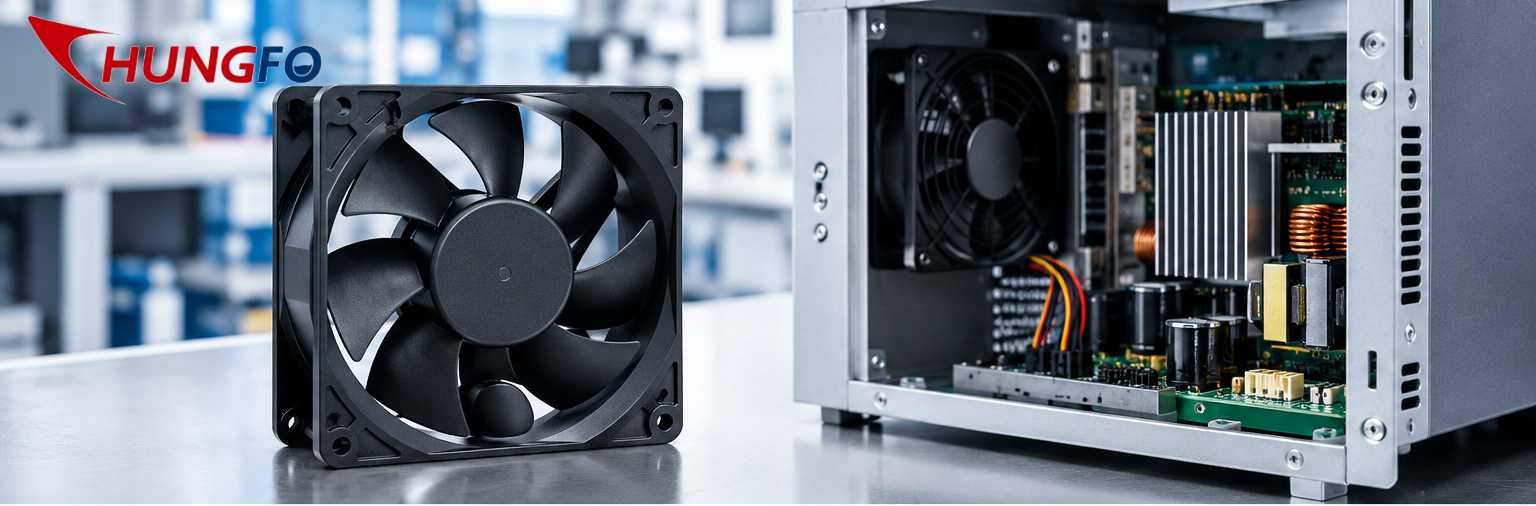
A 12025 fan normally refers to a fan with a nominal frame size of 120 mm × 120 mm and a thickness of 25 mm. This size is widely used because it provides a useful balance between airflow capacity, installation area, power consumption, and packaging space. However, two fans with the same 120 × 120 × 25 mm dimensions can have significantly different performance characteristics.
For example, published 12025 product specifications show that 12 V models can range from relatively low-speed versions with airflow around 56 CFM to high-speed versions exceeding 90 or even 100 CFM, depending on the motor, blade design, bearing system, and operating point. Similar variations exist among 24 V models.
Therefore, the correct selection process should begin with the cooling requirement of the equipment rather than simply searching for a 12025 fan by size.
For most applications, engineers should answer five questions first.
1.Does the 12025 fan physically fit the available installation space?
2.Does its rated voltage match the equipment power architecture?
3.Can it provide enough airflow at the actual system resistance?
4.Can its noise, temperature, vibration, and service-life characteristics satisfy the application?
5.Does its electrical interface and control function match the equipment controller?
If these five questions are answered before procurement, many common integration problems can be avoided.
2.Key Takeaways
The first specification to confirm is the actual physical dimension. A typical 12025 cooling fan measures approximately 120 mm × 120 mm × 25 mm, but mounting-hole dimensions, cable outlet position, connector size, and surrounding clearance must also be checked.
The second important specification is voltage. A 12v dc fan and a 24 V version may have the same physical dimensions while requiring completely different electrical conditions. Published products demonstrate that 12025 fans are available in both 12 V and 24 V versions, with different current and power requirements.
The third consideration is airflow. Maximum airflow is normally measured under relatively open conditions. It should not automatically be treated as the airflow available after the fan is installed inside a real machine.
The fourth consideration is static pressure. A fan installed behind a filter, heat exchanger, grille, duct, enclosure, or dense electronic assembly may need stronger pressure capability than an open-air cooling application.
The fifth consideration is acoustic performance. Higher speed can increase airflow and pressure, but it can also increase noise. Some published 12025 models provide lower-speed versions for quieter operation and higher-speed versions for greater cooling performance.
The sixth consideration is reliability. Bearing type, motor design, operating temperature, humidity, dust, vibration, and continuous operating hours all influence service life.
Finally, the fan should be evaluated as part of the entire thermal system rather than as an independent component.
3.Understand What 12025 Actually Means
The name 12025 is primarily a dimensional designation.
In a conventional axial fan naming system, 120 usually indicates a nominal frame width and length of approximately 120 mm, while 25 indicates an approximate frame thickness of 25 mm.
Therefore, a standard 12025 cooling fan is generally designed around a 120 mm × 120 mm × 25 mm form factor.
This dimensional format is useful because engineers can quickly identify whether a fan may fit a particular equipment enclosure. However, the model number itself does not tell you the airflow, pressure, speed, current, noise, bearing type, or lifetime.
This distinction is extremely important in procurement.
For example, one 12025 fan may operate at 1,500 RPM, while another may operate above 3,000 RPM. One may be optimized for low noise, while another may prioritize static pressure. One may use sleeve bearings, while another may use dual ball bearings. Some models can also include PWM speed control, FG speed feedback, RD alarm output, automatic restart, or waterproof protection.
Consequently, “12025” should be treated as the starting point of the selection process, not the final specification.
4.Check The Installation Dimensions First
Before comparing electrical or airflow specifications, verify the mechanical interface.
The most basic requirement is the overall fan size. A standard 12025 configuration occupies approximately 120 mm × 120 mm of mounting area and has a nominal thickness of 25 mm.
However, engineers should also check the following details:
Mounting-hole spacing,Mounting-hole diameter,Screw type,Frame thickness,Cable exit position,Connector location,Fan orientation,Clearance around the inlet,Clearance around the outlet,Potential interference with nearby components.
A fan can technically have the correct 12025 dimensions but still be unsuitable if its cable exits toward a heat sink, PCB connector, structural bracket, or moving mechanism.
The inlet and outlet clearance also matter. If the suction side is placed directly against a wall, filter, or narrow opening, the fan may not receive enough air. If the outlet is blocked by a grille or heat exchanger, system resistance may increase significantly.
This is why the mechanical integration should be checked using the actual equipment structure rather than a simple dimension drawing.
5.Check Rated Voltage And Operating Voltage
Voltage compatibility is one of the most basic electrical requirements.
A 12v dc fan is designed around a 12 V DC power system, while a 24 V version is intended for a 24 V DC system. The rated voltage is not interchangeable simply because the mechanical dimensions are identical.
Published 12025 specifications show examples of both 12 V and 24 V products, with operating ranges such as approximately 7.0 to 13.8 V for some 12 V models and approximately 14.0 to 27.6 V for some 24 V models.
This means engineers should not only look at the nominal voltage. The actual operating voltage range must also be checked.
For equipment powered by a regulated DC supply, this may be relatively straightforward.
For battery-powered equipment, industrial control systems, vehicles, telecom equipment, or systems with voltage fluctuations, the operating range becomes much more important.
If the fan is expected to operate at a voltage outside its specified range, several problems may occur, including failure to start, unstable operation, excessive current, reduced motor life, or abnormal noise.
6.Compare Rated Current And Input Power
Rated current determines how much electrical current the fan normally draws under its specified operating condition.
Input power can generally be estimated using the relationship:
Input Power = Voltage × Current
For example, a 12 V fan drawing 0.25 A has a nominal electrical input of approximately 3 W.
A 24 V fan drawing 0.20 A has a nominal electrical input of approximately 4.8 W.
Published 12025 product tables demonstrate how substantially current and power can change between different speed versions even when the physical size remains identical.
This matters when integrating multiple fans.
Suppose an equipment cabinet uses six fans. A difference of only 1 W per fan could result in approximately 6 W of additional electrical consumption and heat generation.
Engineers should therefore consider both the fan's own power consumption and the capacity of the equipment power supply.
The controller, connector, wiring, fuse, PCB traces, and switching components should also be rated appropriately.
7.Evaluate RPM Carefully
RPM indicates how quickly the impeller rotates.
A higher RPM can potentially increase airflow and pressure, but speed alone does not determine cooling performance.
Blade geometry, motor efficiency, frame design, inlet conditions, and system resistance all influence actual performance.
For example, available 12025 products show versions operating around 1,500 RPM, 1,800 RPM, 2,000 RPM, 2,200 RPM, 2,500 RPM, 2,800 RPM, 3,000 RPM, and above 3,000 RPM.
This wide range explains why selecting a fan simply by size can produce poor results.
If an electronic enclosure requires quiet operation, a lower-speed model may be more appropriate.
If the equipment contains a high-density heat exchanger or strong airflow resistance, a higher-pressure model may be necessary.
The target RPM should therefore be determined together with airflow, pressure, noise, and thermal requirements.
8.Check Maximum Airflow
Airflow is one of the most frequently searched specifications when selecting a cooling fan.
It may be expressed as CFM or cubic meters per minute.
CFM is commonly used in international fan specifications. However, the maximum airflow value should be interpreted carefully.
Maximum airflow generally represents a condition with relatively low system resistance. Once the fan is installed inside equipment, filters, grilles, ducts, heat sinks, and other components create resistance.
The actual operating airflow can therefore be lower than the advertised maximum airflow.
For example, published 12025 models can provide airflow ranging from roughly 50 CFM to more than 100 CFM depending on voltage, speed, and design.
Therefore, an engineer should ask:
What airflow is required at the actual system pressure?
This question is more useful than asking only:
What is the maximum CFM?
9.Check Static Pressure
Static pressure is especially important when the fan must push air through resistance.
Typical resistance sources include:
Air filters,Dust screens,Heat exchangers,Radiators,Electronic components,Narrow ventilation openings,Protective grilles,Long ducts,Dense equipment layouts.
If an application contains significant resistance, a fan with high maximum airflow but insufficient pressure may perform worse than expected.
For example, published 12025 models show static-pressure values ranging from around 1 to more than 10 mmH2O depending on design and speed.
This demonstrates why airflow and static pressure should always be evaluated together.
10.Use The Fan Curve Instead Of Looking At One Number
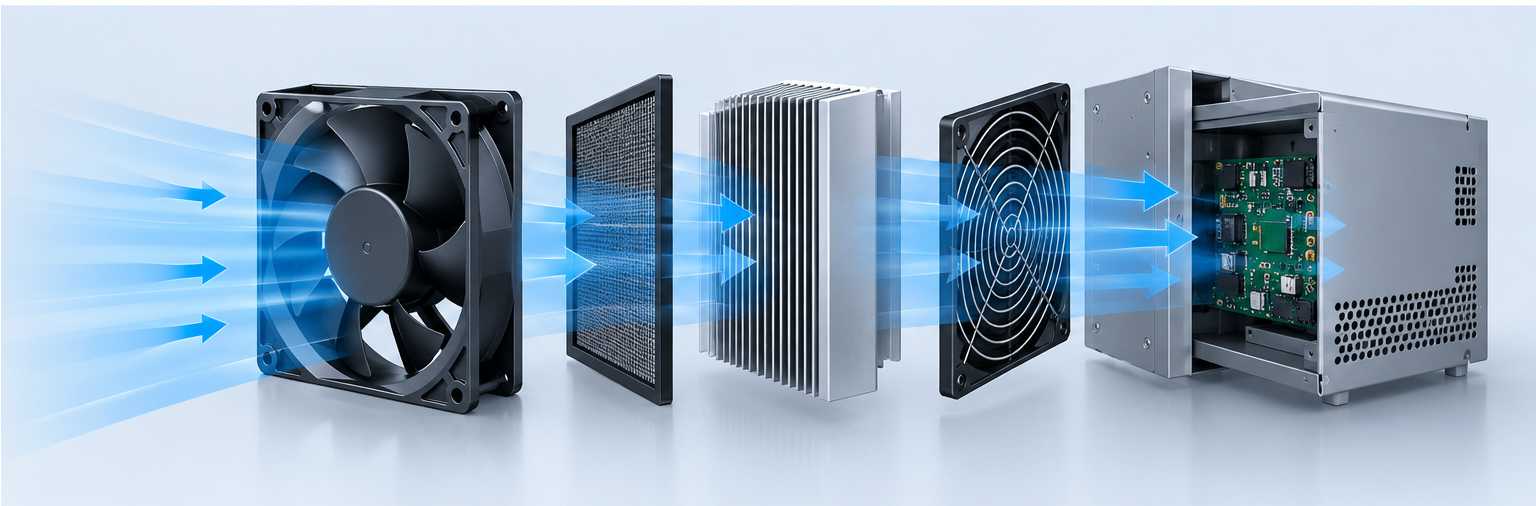
The most useful engineering document for fan selection is often the P-Q curve, also called the pressure-flow curve.
The curve shows the relationship between airflow and static pressure.
At low system resistance, the fan can move more air.
As system resistance increases, the actual airflow decreases.
The correct operating point is determined by the intersection between the fan curve and the system resistance curve.
This concept is particularly important for enclosed industrial equipment.
A fan advertised at 80 CFM does not necessarily deliver 80 CFM after installation.
The correct question is whether it can deliver the required airflow at the pressure created by the equipment.
Therefore, when evaluating a 12025 fan, request the manufacturer's P-Q curve whenever possible.
11.Check Noise Level
Noise is another major consideration.
Published 12025 models demonstrate noise levels ranging from the high 20 dB(A) range for some low-speed configurations to above 40 dB(A) for higher-speed models.
A higher airflow target may therefore create an acoustic trade-off.
For office equipment, medical devices, laboratory instruments, residential appliances, and other noise-sensitive products, noise should be considered during the initial fan selection rather than after prototype assembly.
The following factors can influence perceived noise:
Fan RPM,Blade geometry,Motor commutation,Bearing condition,Air turbulence,Grille design,Mounting vibration,Enclosure resonance
Poorly designed air channels can also create significant turbulence noise even when the fan itself has a relatively low noise rating.
12.Choose The Correct Bearing Type
Bearing selection affects reliability, noise, installation orientation, temperature tolerance, and service life.
Common bearing options include sleeve bearings, hydraulic bearings, and ball bearings.
Some published 12025 fans are offered with sleeve or hydraulic bearings, while others use two ball bearings.
Sleeve-bearing fans can be suitable for cost-sensitive applications and certain environmental conditions.
Ball-bearing fans are often considered when continuous operation, higher temperature, installation orientation, or longer service life is important.
However, engineers should not assume that one bearing type is automatically appropriate for every application.
The actual temperature, operating hours, mounting direction, vibration, dust, humidity, and required lifetime should be evaluated together.
13.Verify Operating Temperature And Humidity
The environmental conditions of the equipment can be very different from the temperature inside the factory.
A fan used in a server enclosure, industrial cabinet, refrigeration system, charging system, or outdoor device may experience elevated temperatures.
Published 12025 specifications show operating ranges such as approximately minus 10°C to plus 70°C for some sleeve-bearing models and minus 20°C to plus 80°C for some ball-bearing models.
These values are examples rather than universal requirements.
Engineers should request the exact environmental specification of the selected model.
Humidity should also be considered.
High humidity, condensation, dust, salt spray, and corrosive gases may require special materials or protective treatment.
14.Consider IP Protection
For equipment exposed to water, dust, condensation, or outdoor environments, IP protection can be critical.
Some 12025 product families offer options such as IP54, IP55, IP56, IP66, IP67, or IP68.
However, IP rating should not be treated as a universal feature of every 12025 fan.
The engineer must confirm the exact IP rating of the selected model.
An IP-rated fan may also require appropriate cable sealing, connector protection, mounting gasket design, and enclosure integration.
The system's final protection level depends on the complete assembly rather than the fan alone.
15.Check Control And Feedback Functions
Modern equipment may require more than two power wires.
A basic DC fan may use positive and negative power connections.
More advanced configurations may include:
FG speed feedback,RD alarm output,PWM speed control,Temperature-related control,Automatic restart,Locked-rotor protection,Polarity protection.
These functions can help the equipment controller monitor and regulate fan operation.
For example, PWM can allow a controller to adjust fan speed according to thermal load.
FG feedback can provide rotational-speed information.
RD can indicate a fault condition.
If the equipment requires these functions, they should be specified before purchasing samples.
16.Check Connector And Wire Configuration
Electrical integration can fail even when voltage and current are correct.
The connector may not match.
The wire length may not be sufficient.
The polarity may differ.
The pin definition may be different.
The wire gauge may not suit the installation.
Some 12025 fans use two wires, while other configurations can use three or four wires for sensing or PWM functions.
Therefore, engineers should confirm:
Wire count,Wire color,Connector model,Pin definition,Wire length,Wire gauge,Polarity,Signal type,Connector locking method.
These details should appear clearly in the engineering specification.
17.Check Motor Protection Features
A reliable fan should be evaluated for abnormal operating conditions.
Useful protection features may include locked-rotor protection, automatic restart, polarity protection, and thermal protection.
A blocked fan can create a significantly different operating condition from normal operation.
If the impeller is prevented from rotating by a foreign object, dust accumulation, mechanical interference, or an installation problem, the motor may behave differently.
For equipment expected to operate unattended for long periods, protection functions should therefore be included in the fan selection criteria.
18.Evaluate Materials
The frame and impeller materials influence mechanical strength, temperature resistance, flame resistance, chemical resistance, and long-term stability.
Many 12025 products use engineering plastics such as PBT.
One published 12025 specification lists PBT with UL94V-0 flame-retardant material for both frame and impeller.
Material selection should match the application.
Industrial equipment may require higher temperature resistance.
Electrical equipment may require flame-retardant materials.
Outdoor applications may require better environmental resistance.
Medical or laboratory equipment may have additional material and cleaning requirements.
19.Verify Reliability And Expected Life
Fan life should be considered in terms of operating conditions.
A manufacturer may provide a life estimate under a specified temperature and operating condition.
For example, one 120 × 120 × 25 mm DC axial fan specification from China Chungfo Fan lists sleeve or double-ball bearing options and states a working life of up to 50,000 hours at 25°C for the relevant configuration.
This figure should not be interpreted as a guarantee that every fan will operate for exactly 50,000 hours.
Actual life can be affected by:
Ambient temperature,Bearing type,RPM,Operating hours,Vibration,Humidity,Dust,Electrical stress,Installation orientation,Maintenance conditions.
The correct approach is to evaluate expected life under the actual application environment.
20.Check Certification Requirements
Different industries may have different certification requirements.
Depending on the target market and equipment category, engineers may need to consider certifications or compliance requirements related to electrical safety, materials, electromagnetic compatibility, environmental regulations, or fire resistance.
Published 12025 fan specifications may list CE, RoHS, UL, or other compliance information.
However, certification should always be verified against the exact model.
A manufacturer may have certification for one product family but not necessarily every customized configuration.
For OEM projects, customers should request the relevant certificate, test report, or component recognition information before mass production.
21.12 V And 24 V Versions Are Not Simply Interchangeable
A common mistake is assuming that a 12025 fan can be selected according to size first and voltage later.
This approach can cause electrical problems.
A 12 V fan is designed for a different electrical operating range than a 24 V fan.
The motor winding, driver circuit, current, and power characteristics may all differ.
For example, published 12025 specifications show 12 V and 24 V versions with different rated currents even when their airflow and speed ranges are similar.
The equipment designer should therefore define the power architecture first.
If the system uses a 24 V industrial control supply, a 12025 fan designed specifically for 24 V operation may simplify integration.
If the system uses a 12 V electronics platform, a 12 V version may be more appropriate.
22.How To Select A 12025 Fan For Different Applications
Different applications require different priorities.
For an electronic enclosure, airflow and pressure are usually important.
For a residential appliance, noise and reliability may receive greater attention.
For an industrial cabinet, voltage compatibility, lifetime, protection, and maintenance may become major concerns.
For outdoor equipment, environmental protection may become critical.
For battery-powered equipment, efficiency and power consumption are particularly important.
For medical or laboratory equipment, noise, reliability, materials, and traceability may be important.
Therefore, there is no single “best” 12025 specification for every application.
The correct specification is the one that matches the system's actual operating requirements.
23.Comparison Table For 12025 Fan Selection
Specification | What To Check | Why It Matters
Size | 120 × 120 × 25 mm | Determines mechanical compatibility
Rated voltage | 12 V, 24 V, or other | Prevents electrical mismatch
Operating voltage | Minimum and maximum voltage | Confirms stable operation
Current | Rated and startup current | Determines power-supply requirements
Power | Input watts | Affects energy consumption and thermal load
RPM | Rated speed | Influences airflow, pressure, and noise
Airflow | CFM or m³/min | Indicates cooling capacity
Static pressure | mmH2O or Pa | Determines performance against resistance
P-Q curve | Airflow-pressure relationship | Helps identify actual operating point
Noise | dB(A) | Important for acoustic performance
Bearing | Sleeve, hydraulic, ball | Influences life and environmental suitability
Temperature | Operating temperature range | Confirms environmental compatibility
Humidity | Permitted humidity range | Important for condensation and reliability
IP rating | IP54 to IP68 depending on model | Protects against dust and water
Control | PWM, FG, RD | Enables monitoring and speed control
Protection | Locked-rotor, restart, polarity protection | Improves system reliability
Material | Frame and impeller material | Influences durability and safety
Certification | Applicable market requirements | Supports compliance
Connector | Pinout and connector type | Simplifies electrical integration
Service life | Rated lifetime at specified conditions | Supports maintenance planning
24.A Practical Integration Example From China Chungfo Fan
A practical example can help demonstrate why the complete specification matters.
China Chungfo Fan provides a 120 × 120 × 25 mm DC brushless axial fan configuration designed for cooling applications. The published product information lists DC 5 V, 12 V, and 24 V operating options, current values in the approximate 0.10 to 0.35 A range for the listed configuration, speeds around 1,600 to 2,000 RPM, airflow around 56.56 to 73.95 CFM, noise around 25 to 33 dBA, and static pressure around 1.50 to 2.50 mmAq. The product information also lists PBT material, sleeve or double-ball bearing options, automatic restart or polarity protection, and a stated life of up to 50,000 hours at 25°C for the relevant configuration.
This example demonstrates an important engineering principle.
The physical size alone does not define the fan.
The complete specification defines the usable fan.
Suppose an equipment designer needs a 120 × 120 × 25 mm fan for a compact electronic cabinet.
The designer should first calculate the thermal load.
Next, the required airflow should be estimated.
Then the resistance caused by filters, grilles, heat sinks, and internal airflow channels should be considered.
The required static pressure can then be estimated.
Only after these steps should the designer compare available fan curves.
After the aerodynamic requirement is confirmed, the designer should verify voltage, current, noise, temperature, bearing, life, connector, and control functions.
This sequence significantly reduces the risk of selecting a fan that fits mechanically but fails thermally.
25.Common Mistakes When Integrating A 12025 Cooling Fan
The first mistake is selecting only according to dimensions.
The second mistake is selecting according to maximum CFM without checking static pressure.
The third mistake is ignoring the difference between rated voltage and actual operating voltage.
The fourth mistake is ignoring startup current.
The fifth mistake is selecting a high-speed fan without considering noise.
The sixth mistake is ignoring bearing type in continuous-operation equipment.
The seventh mistake is assuming an IP rating without verifying the exact model.
The eighth mistake is failing to confirm connector and wire definitions.
The ninth mistake is assuming that certification of one model automatically applies to another customized model.
The tenth mistake is testing the fan outside the final enclosure and assuming the result represents the actual system.
26.How To Test The Fan Before Mass Production
Prototype testing should be performed under conditions that resemble the final product.
First, confirm the physical installation.
Second, measure operating voltage and current.
Third, verify startup behavior.
Fourth, measure airflow or evaluate thermal performance.
Fifth, evaluate noise at the final mounting position.
Sixth, check vibration.
Seventh, test the equipment at minimum and maximum expected voltage.
Eighth, evaluate high-temperature operation if required.
Ninth, test abnormal conditions such as blocked airflow where appropriate.
Tenth, conduct a reliability test for long-running equipment.
Testing should focus on the complete system rather than the fan alone.
27.How To Create A 12025 Fan Specification Sheet For Procurement
A clear procurement specification can include the following information.
Fan size: 120 × 120 × 25 mm
Fan type: DC brushless axial fan
Rated voltage: 12 V or 24 V
Operating voltage range: defined by manufacturer
Rated current: specified value
Input power: specified value
Speed: required RPM range
Airflow: required CFM
Static pressure: required mmH2O or Pa
Noise: maximum permitted dB(A)
Bearing: required bearing type
Operating temperature: required range
Humidity: required range
Protection: required IP rating
Control: PWM, FG, RD, or basic two-wire
Connector: specified model
Wire length: specified length
Material: specified requirement
Certification: required market certifications
Expected life: required operating hours
This type of document makes communication between the equipment designer, purchasing team, fan manufacturer, and quality department much easier.
28.Why Customization Can Be Important
A standard 12025 fan may satisfy the basic mechanical requirement but still fail to meet the complete application requirements.
In OEM projects, manufacturers may be able to customize voltage, speed, airflow, pressure, noise, wire length, connector, bearing, material, protection function, and other specifications.
This can be useful when the standard product has too much airflow, insufficient pressure, excessive noise, or an unsuitable electrical interface.
For example, a customer may require a 12025 fan with a specific connector and PWM function for automatic thermal control.
Another customer may require a waterproof version for outdoor equipment.
A third customer may prioritize low noise for a residential appliance.
Therefore, engineering communication should focus on the actual operating requirements instead of only requesting “a 12025 fan.”
29.Recommended Engineering Selection Process
A practical selection process can follow these steps.
Step one is to define the installation space.
Step two is to calculate the heat that needs to be removed.
Step three is to estimate the required airflow.
Step four is to estimate system resistance.
Step five is to determine the required static pressure.
Step six is to compare fan curves.
Step seven is to select voltage.
Step eight is to evaluate current and power.
Step nine is to evaluate noise.
Step ten is to select the bearing and environmental rating.
Step eleven is to confirm control and feedback functions.
Step twelve is to verify connector and wiring.
Step thirteen is to review certifications.
Step fourteen is to conduct prototype testing.
Step fifteen is to perform reliability validation before mass production.
This method is more reliable than choosing a fan based only on the 12025 designation.
30,FAQ
Q1: What does 12025 mean on a cooling fan?
12025 normally refers to a nominal fan size of approximately 120 mm × 120 mm × 25 mm. It describes the physical form factor, not the complete electrical or aerodynamic performance.
Q2: Is a 12 V 12025 fan better than a 24 V version?
Neither voltage is universally suitable for every application. The correct choice depends on the equipment's power architecture. The rated voltage and operating voltage range should match the system power supply.
Q3: How much airflow does a 12025 fan provide?
There is no single airflow value for every 12025 fan. Published models show a wide range depending on speed, motor, blade geometry, and design. Some products provide approximately 50 to 100 CFM or more.
Q4: Why is static pressure important?
Static pressure indicates how effectively the fan can maintain airflow against resistance. It is particularly important when the fan operates behind filters, grilles, heat exchangers, ducts, or dense components.
Q5: Should I choose a ball-bearing 12025 fan?
A ball-bearing design can be considered when continuous operation, temperature, mounting orientation, and service life are important. The final selection should be based on actual operating conditions rather than bearing type alone.
Q6: Can a 12025 fan be used outdoors?
It can be used in outdoor equipment when the selected model has an appropriate environmental and IP rating. Some 12025 product families offer waterproof options, but the exact model specification must be verified.
Q7: Does higher RPM always mean better cooling?
No. Higher RPM can increase airflow and pressure, but it can also increase noise and power consumption. The best operating point depends on the complete thermal system.
Q8: What should I ask a fan manufacturer before purchasing?
At minimum, request the dimensional drawing, rated voltage, operating voltage range, current, power, RPM, airflow, static pressure, P-Q curve, noise, bearing type, temperature range, humidity range, protection functions, wire configuration, connector information, certification, and expected service life.
Q9: Can the same 12025 frame be customized for different applications?
Yes. Depending on the manufacturer and project requirements, customization may be available for voltage, speed, airflow, pressure, noise, bearing, wire, connector, control functions, materials, and environmental protection.
Q10: What is the most important specification when integrating a 12025 fan?
There is no single specification that is sufficient for every project. The most important approach is to match airflow and static pressure to the actual thermal system, then verify voltage, noise, reliability, environmental conditions, control interface, and mechanical compatibility.
31.Final Checklist Before Integrating A 12025 Cooling Fan
Before approving a 12025 fan for production, engineers can use this checklist.
Confirm the 120 × 120 × 25 mm installation dimensions.
Confirm mounting-hole dimensions.
Confirm rated voltage.
Confirm operating voltage range.
Confirm rated and startup current.
Confirm input power.
Confirm RPM.
Confirm maximum airflow.
Confirm static pressure.
Review the P-Q curve.
Confirm noise level.
Confirm bearing type.
Confirm operating temperature.
Confirm humidity.
Confirm IP protection if required.
Confirm motor protection.
Confirm PWM, FG, or RD functions if required.
Confirm wire length and connector.
Confirm material and flame rating.
Confirm certification.
Confirm expected service life.
Test the fan in the actual equipment.
Verify thermal performance under realistic system resistance.
Verify acoustic performance after installation.
Verify reliability before mass production.
A 12025 cooling fan may look like a simple standardized component, but its actual performance depends on the relationship between electrical input, motor design, blade geometry, airflow resistance, environmental conditions, and system architecture.
For this reason, engineers should not select a fan simply because the dimensions are correct. The right 12025 solution is the one that can meet the required thermal performance while also satisfying electrical, acoustic, mechanical, environmental, reliability, and compliance requirements.
For OEM and industrial applications, working directly with a manufacturer such as China Chungfo Fan can also make it easier to evaluate different voltage, speed, airflow, pressure, bearing, connector, protection, and control configurations before finalizing the production specification.