Kategori
Blog baru.
Bagaimana Cara Melindungi Kipas Pendingin Udara Luar Ruangan dari Penurunan Kualitas Segel Kedap Air IP68?
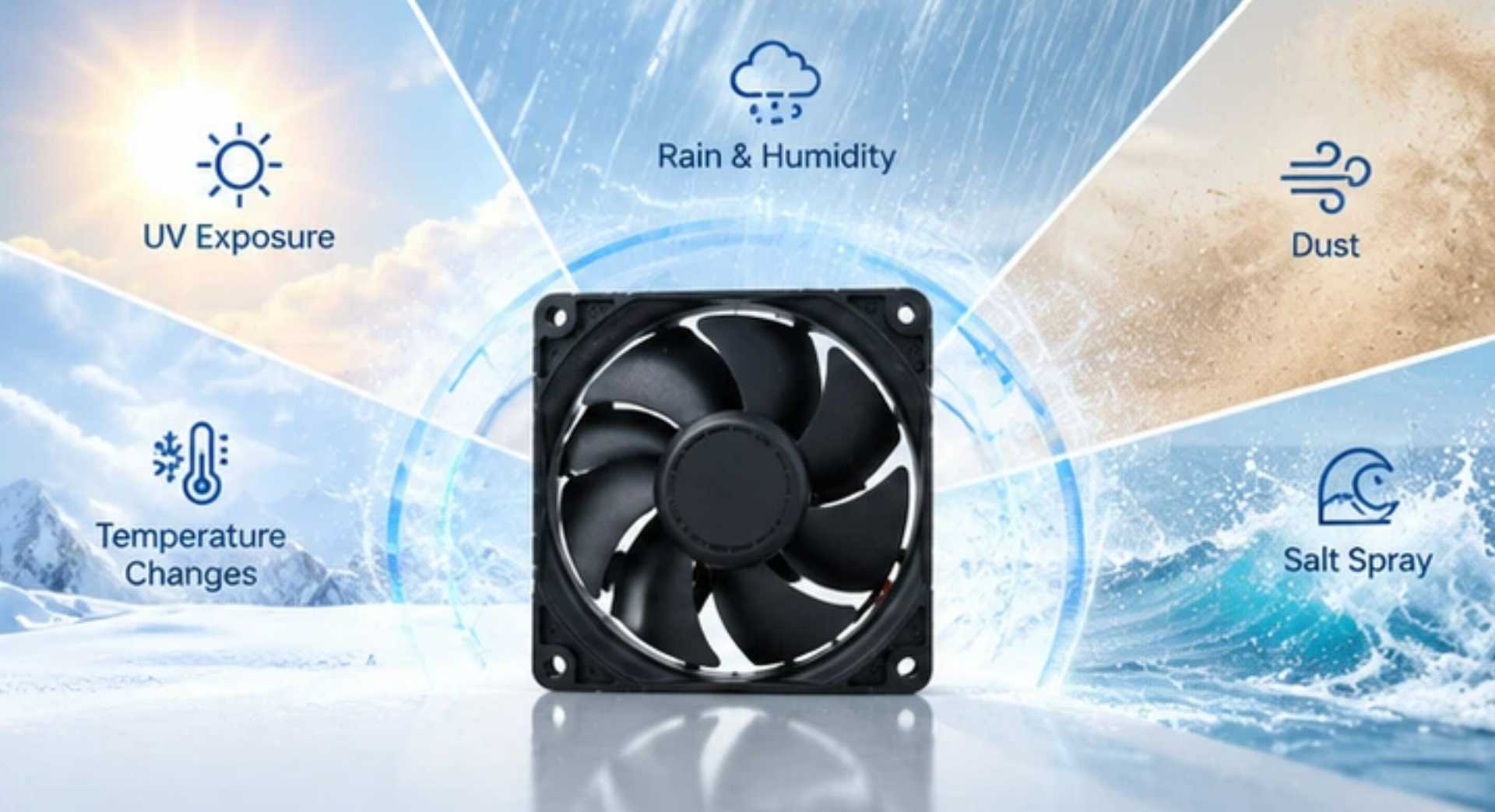
September 07 , 2026Kipas pendingin udara luar ruangan semakin banyak digunakan pada peralatan yang harus beroperasi terus menerus di bawah hujan, kelembapan, debu, perubahan suhu, kabut garam, dan kondisi lingkungan yang menuntut lainnya. Kabinet telekomunikasi, catu daya luar ruangan, peralatan pengisian daya kendaraan listrik, inverter surya, kabinet kontrol industri, sistem pendingin, peralatan pertanian, layar LED, dan banyak sistem lainnya bergantung pada aliran udara paksa untuk menghilangkan panas. Namun, ketika sistem ini dipasang di luar ruangan, kinerja pendinginan hanyalah satu bagian dari persamaan keandalan. Kemampuan kipas untuk mempertahankan perlindungannya terhadap air dan debu selama bertahun-tahun sama pentingnya.
SebuahKipas berperingkat IP68Dirancang untuk memberikan tingkat perlindungan yang sangat tinggi terhadap masuknya debu dan air. Namun, peringkat IP68 tidak boleh diartikan sebagai jaminan bahwa sistem penyegelan akan tetap tidak berubah selamanya. Paparan di luar ruangan menimbulkan tekanan mekanis, termal, kimia, dan lingkungan yang terus menerus. Seiring waktu, segel dapat kehilangan elastisitasnya, perekat dapat menua, titik masuk kabel dapat menjadi rentan, sambungan casing dapat mengalami perubahan dimensi, dan kondensasi dapat menciptakan kelembapan bahkan ketika air hujan langsung tidak masuk ke dalam peralatan.
Ini berarti bahwa melindungi kipas pendingin udara luar ruangan dari degradasi segel kedap air IP68 memerlukan strategi keandalan yang lengkap, bukan hanya sekadar memilih kipas dengan label IP68.
Oleh karena itu, bagi produsen peralatan dan insinyur, pertanyaan terpenting bukanlah hanya apakah kipas dapat lolos uji IP68 saat masih baru, tetapi juga apakah struktur penyegelan kipas, material, komponen listrik, bantalan, sambungan kabel, dan lingkungan pemasangan dapat terus berfungsi dengan andal sepanjang masa pakai yang diharapkan.
Apa Arti Sebenarnya dari IP68 untuk Kipas Pendingin Luar Ruangan?
Kode IP digunakan untuk menggambarkan tingkat perlindungan yang diberikan oleh suatu wadah terhadap benda padat dan air. Angka pertama berkaitan dengan perlindungan terhadap partikel padat, sedangkan angka kedua berkaitan dengan perlindungan terhadap air. IP68 mewakili tingkat perlindungan debu yang tinggi bersamaan dengan perlindungan terhadap perendaman air dalam kondisi pengujian yang ditentukan. Kondisi perendaman yang tepat yang terkait dengan klaim IP68 dapat bergantung pada kondisi pengujian yang dinyatakan oleh produsen dan persyaratan yang berlaku.
Perbedaan ini penting untuk pemilihan kipas angin luar ruangan.
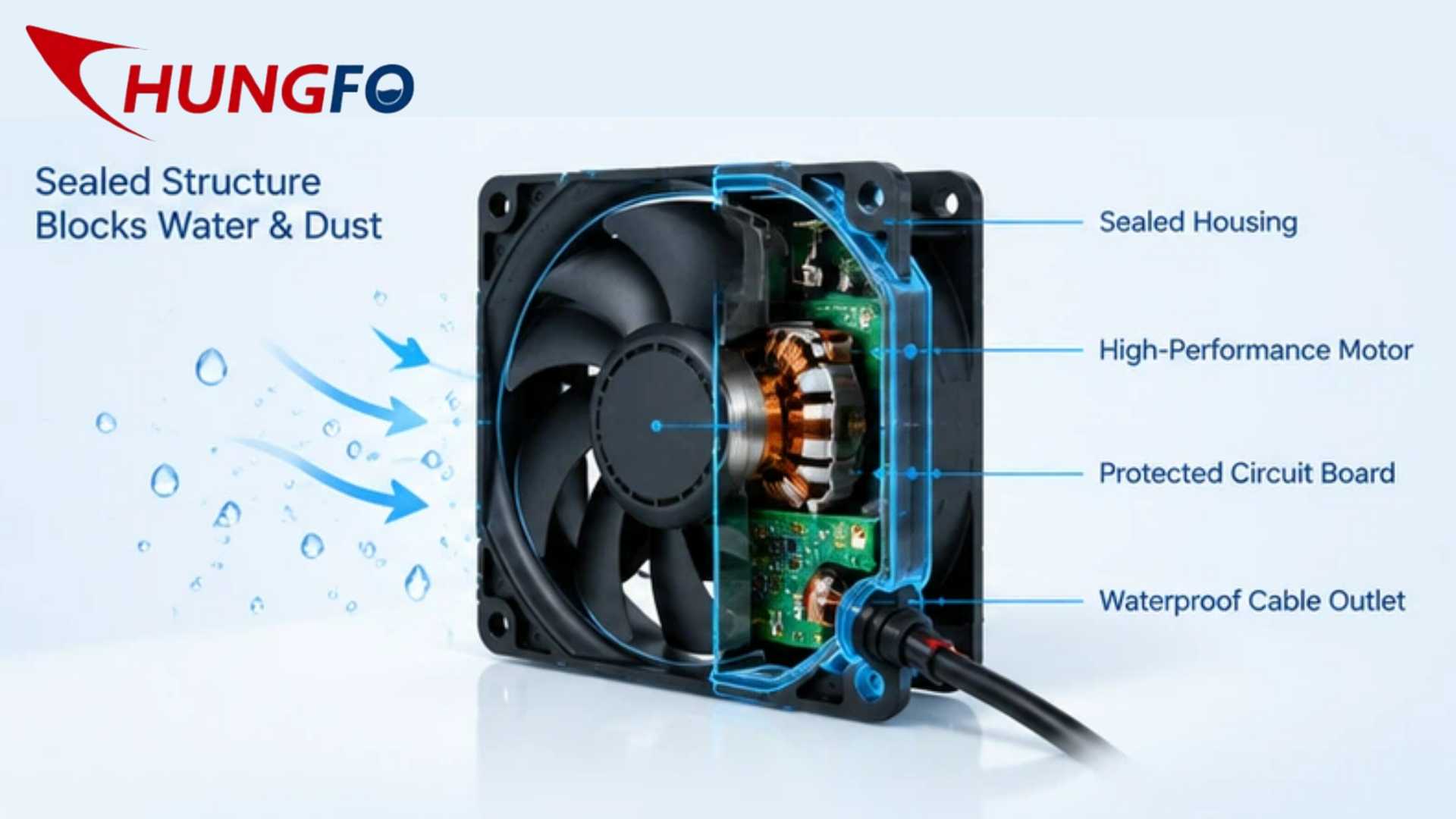
Kipas IP68 bukanlah sekadar kipas konvensional dengan penutup karet di sekelilingnya. Untuk mencapai perlindungan yang andal, produsen biasanya perlu mengontrol beberapa jalur masuk air potensial. Ini mungkin termasuk sambungan casing, saluran keluar kabel, konektor, struktur motor, papan sirkuit, area bantalan, dan antarmuka lainnya.
Kipas tahan air yang dirancang dengan baik dapat menggunakan kombinasi struktur rumah tertutup, perlindungan resin, lapisan konformal, saluran kabel tahan air, bantalan khusus, material tahan korosi, dan proses manufaktur yang dikontrol dengan cermat. Contoh industri menunjukkan bahwa pengemasan atau enkapsulasi dapat digunakan untuk mengisolasi gulungan dan papan sirkuit dari lingkungan eksternal.
Namun, tingkat perlindungan yang diukur selama pengujian produksi mewakili kondisi tertentu pada titik waktu tertentu. Peralatan luar ruangan menghadapi siklus suhu berulang, getaran, paparan sinar ultraviolet, kontaminasi kimia, dan tekanan mekanis. Faktor-faktor ini secara bertahap dapat mengubah sifat-sifat bahan penyegel.
Oleh karena itu, perlindungan jangka panjang harus dianggap sebagai masalah rekayasa tingkat sistem.
Mengapa Segel Kedap Air IP68 Dapat Mengalami Penurunan Kualitas Seiring Waktu?
Kesalahan paling umum dalam desain pendingin luar ruangan adalah menganggap bahwa kedap air merupakan karakteristik permanen produk. Padahal, setiap sistem penyegelan dipengaruhi oleh lingkungannya.
Siklus suhu adalah salah satu faktor terpenting.
Kipas luar ruangan mungkin mengalami malam yang dingin, sinar matahari langsung di siang hari, permukaan peralatan yang panas, hujan tiba-tiba, dan perubahan suhu musiman. Casing plastik, segel karet, perekat, komponen logam, dan bahan resin tidak selalu mengembang dan menyusut dengan laju yang sama.
Ekspansi dan kontraksi yang berulang dapat menimbulkan tekanan pada antarmuka.
Jika segel menjadi lebih keras, lebih lunak, tertekan, membengkak, atau mengalami deformasi permanen, tekanan kontaknya dapat secara bertahap berkurang. Perubahan kecil mungkin tidak langsung menyebabkan kebocoran yang terlihat, tetapi dapat menciptakan jalur bagi kelembapan selama paparan lingkungan yang berulang.
Siklus termal juga penting karena wadah elektronik luar ruangan dapat mengalami perubahan tekanan. Ketika udara di dalam memanas dan mengembang, kemudian mendingin dan menyusut, wadah dapat mengalami fluktuasi tekanan. Dalam jangka waktu yang lama, siklus ini dapat menguji antarmuka penyegelan yang lemah. Penelitian teknik pada wadah tertutup luar ruangan telah mengidentifikasi ekspansi dan kontraksi termal sebagai faktor potensial penyebab kegagalan segel dan masalah kondensasi.
Paparan sinar ultraviolet merupakan masalah lain.
Kipas yang dipasang di luar ruangan dapat terpapar sinar matahari selama ribuan jam. Tergantung pada materialnya, radiasi ultraviolet dapat menyebabkan perubahan warna, kerapuhan, retak permukaan, atau hilangnya sifat mekanik. Oleh karena itu, pemilihan material yang sesuai untuk paparan luar ruangan sangat penting ketika rumah kipas atau struktur penyegelan terpapar langsung sinar matahari.
Kelembapan menciptakan tantangan jangka panjang lainnya.
Lingkungan yang lembap tidak selalu memerlukan kontak langsung dengan air untuk menimbulkan masalah keandalan. Kelembapan dapat merambat melalui antarmuka yang rentan, konektor, struktur kabel, atau cacat mikroskopis. Kelembapan tinggi juga dapat mempercepat korosi komponen logam dan kontak elektronik.
Kabut garam bisa sangat agresif.
Peralatan luar ruangan yang dipasang di dekat daerah pesisir mungkin terpapar partikel garam dan uap air di udara. Kontaminasi garam dapat mempercepat korosi pada bagian logam, konektor, pengencang, dan antarmuka listrik. Oleh karena itu, produsen kipas lingkungan sering menyediakan desain tahan korosi khusus untuk aplikasi yang melibatkan semprotan garam dan uap air.
Debu dapat memperparah masalah.
Partikel debu dapat menumpuk di sekitar segel dan antarmuka mekanis. Jika debu mengandung partikel abrasif atau aktif secara kimia, gerakan atau getaran berulang dapat secara bertahap memengaruhi permukaan penyegelan. Ketika debu bercampur dengan kelembapan, ia dapat membentuk endapan yang lebih sulit untuk dihilangkan.
Bagaimana Casing Kipas Dapat Melindungi Segel Kedap Air?
Rumah kipas merupakan garis pertahanan utama pertama terhadap kontaminasi lingkungan.
Kipas luar ruangan yang kokoh harus memiliki struktur rumah yang meminimalkan bukaan yang tidak perlu dan menciptakan antarmuka penyegelan yang terkontrol. Semakin sedikit bukaan yang tidak terkontrol, semakin mudah untuk menjaga perlindungan lingkungan yang andal.
Sambungan pada rumah harus dirancang dengan cermat.
Sambungan mekanis sederhana mungkin tidak memberikan perlindungan jangka panjang yang memadai kecuali permukaan kontak, kompresi gasket, toleransi, dan metode pengencangan dikontrol dengan benar. Tergantung pada desainnya, produsen dapat menggunakan gasket, senyawa penyegel, pengisian resin, pengecoran, pencetakan berlebih, atau teknologi lainnya.
Tujuannya bukan sekadar membuat wadah sulit dibuka. Tujuannya adalah untuk menciptakan penghalang yang stabil terhadap air sekaligus mempertahankan integritas mekanis selama getaran dan siklus termal.
Untuk aplikasi yang membutuhkan perlindungan lingkungan yang sangat tinggi, komponen elektronik internal juga dapat dilindungi melalui pelapisan atau enkapsulasi. Beberapa desain kipas IP68 menggunakan teknologi berbasis resin untuk mengisolasi gulungan dan papan sirkuit yang sensitif dari air dan kelembapan.
Pendekatan ini memberikan lapisan perlindungan tambahan.
Jika casing luar mengalami kerusakan kecil, enkapsulasi internal dapat mengurangi kemungkinan kelembapan mencapai komponen listrik yang sensitif.
Mengapa Lubang Keluar Kabel Merupakan Titik Kritis untuk Kedap Air?
Banyak insinyur memberikan perhatian khusus pada rumah kipas tetapi meremehkan saluran keluar kabel.
Kabel harus melewati area internal yang terlindungi ke lingkungan eksternal. Transisi ini menciptakan antarmuka yang tak terhindarkan.
Jika saluran keluar kabel dirancang dengan buruk, air berpotensi merembes di sepanjang kabel atau melalui celah di sekitar titik masuk kabel.
Oleh karena itu, desain kipas tahan air sering menggunakan lubang keluar kabel yang dicetak, senyawa penyegel, kelenjar kabel, konektor tahan air, atau metode penyegelan terkontrol lainnya.
Bahan kabel itu sendiri juga penting.
Kabel luar ruangan harus tahan terhadap perubahan suhu, paparan sinar ultraviolet, kelembapan, tekukan, getaran, dan terkadang bahan kimia. Kabel yang berkinerja baik di dalam ruangan belum tentu memberikan keandalan jangka panjang yang sama di luar ruangan.
Oleh karena itu, sambungan antara kabel dan kipas harus dievaluasi sebagai bagian dari sistem kedap air yang lengkap.
Penggunaan kipas IP68 berkualitas tinggi dengan konektor eksternal yang tidak terlindungi dapat menciptakan titik lemah dalam sistem secara keseluruhan. Kipas mungkin memiliki perlindungan lingkungan yang sangat baik, tetapi perakitan peralatan akhir mungkin tidak.
Bagaimana Kondensasi Mempengaruhi Keandalan Kipas IP68?
Kedap air dan kondensasi adalah dua masalah yang berbeda.
Masuknya air secara langsung terjadi ketika air cair masuk melalui lubang atau segel yang rusak. Kondensasi terjadi ketika uap air yang sudah ada di udara berubah menjadi air cair karena perubahan suhu.
Perbedaan ini sangat penting, terutama pada peralatan elektronik luar ruangan.
Ruang tertutup rapat dapat berisi udara lembap. Selama pengoperasian di siang hari, komponen internal memanaskan udara. Pada malam hari, peralatan mendingin. Jika suhu internal mencapai titik embun, air dapat mengembun pada permukaan yang lebih dingin.
Oleh karena itu, bahkan wadah yang tertutup rapat pun dapat mengalami kelembapan internal jika desain termalnya tidak dikontrol dengan benar.
Oleh karena itu, sistem kipas luar ruangan harus mempertimbangkan perlindungan terhadap masuknya air dan pengelolaan kelembapan.
Dalam beberapa desain penutup, membran berpori dapat digunakan untuk membantu menyeimbangkan tekanan sekaligus membatasi penetrasi air cair. Solusi tersebut harus dipilih dengan cermat karena komponen ventilasi tambahan apa pun dapat memengaruhi perlindungan lingkungan keseluruhan dari penutup tersebut. Panduan teknik untuk penutup IP67 dan IP68 umumnya menekankan penyeimbangan tekanan dan pengelolaan kondensasi sebagai bagian dari keandalan jangka panjang.
Bagaimana Perubahan Suhu Mempengaruhi Segel Kipas?
Perubahan suhu yang berulang-ulang seringkali lebih merusak dalam jangka panjang daripada peristiwa suhu tinggi tunggal.
Bayangkan sebuah kipas pendingin luar ruangan yang beroperasi di dalam kabinet listrik. Pada siang hari, radiasi matahari meningkatkan suhu kabinet. Kipas berputar dengan kecepatan tinggi karena komponen elektronik internal menghasilkan panas. Pada malam hari, sistem mendingin dengan cepat.
Siklus ini dapat terjadi setiap hari.
Casing mengembang dan menyusut. Material penyegel bereaksi secara berbeda. Perekat mengalami tekanan. Selubung kabel sedikit berubah dimensinya. Pelumas di dalam bantalan bereaksi terhadap suhu. Komponen elektronik juga mengalami tekanan termal berulang.
Over thousands of cycles, small changes can accumulate.
This is why outdoor fan qualification should consider the actual operating temperature range rather than only the nominal room-temperature condition.
Selecting a fan designed for the expected temperature range can significantly improve reliability.
The thermal design should also consider the difference between ambient temperature and the temperature inside the equipment. A fan operating in a 40°C outdoor environment may be exposed to a considerably higher internal temperature if the enclosure receives solar radiation or contains high-power electronics.
A suitable outdoor fan therefore needs both environmental protection and thermal capability.
How Can Material Selection Reduce Seal Degradation?
Material selection is one of the most effective ways to improve long-term environmental reliability.
Different rubber, plastic, resin, adhesive, and cable materials behave differently under ultraviolet radiation, heat, humidity, chemicals, and salt exposure.
For sealing applications, engineers should consider compression set, temperature resistance, chemical compatibility, water resistance, and aging characteristics.
For fan housings, material selection should consider mechanical strength, dimensional stability, flame resistance, corrosion resistance, ultraviolet exposure, and operating temperature.
For bearings, moisture resistance and lubricant stability are important.
For cables, flexibility, insulation performance, temperature resistance, and environmental durability should be evaluated.
A waterproof fan should therefore be selected as a complete engineered system rather than simply according to its external appearance.
How Important Are Bearings In An Outdoor Cooling Fan?
The waterproof seal protects electrical components, but the bearing system determines how reliably the impeller can rotate.
Outdoor environments can accelerate lubricant degradation and corrosion if the bearing structure is not suitable for the application.
Water exposure can be particularly damaging to conventional bearing systems.
A bearing that performs well in a clean indoor cabinet may experience different conditions in an outdoor agricultural machine, coastal power system, or industrial enclosure.
For long-life outdoor operation, engineers should consider bearing construction, lubricant characteristics, operating temperature, expected rotational speed, vibration, and environmental exposure.
Some manufacturers offer IP68 fans with specially protected ball bearings or other bearing solutions designed for demanding conditions.
The correct bearing selection also helps prevent secondary failures. If a bearing begins to develop excessive friction, the motor may consume more power, the fan may produce more heat, airflow can decline, and vibration can increase.
Therefore, bearing reliability is closely connected with the entire cooling system.
How Can You Protect An Outdoor Fan From Salt Spray?
Coastal installations require special attention.
Salt mist can reach outdoor equipment even when the fan is not directly exposed to seawater. Tiny salt particles can settle on surfaces and remain there when humidity is high.
Over time, salt contamination can accelerate corrosion.
The best strategy is to combine corrosion-resistant materials with appropriate sealing and, where necessary, additional surface protection.
Metal components should be selected according to the expected environmental conditions. Electrical connectors should have suitable environmental protection. The fan housing should prevent unnecessary exposure of sensitive components.
In particularly demanding applications, salt spray testing can provide useful information about material and surface durability.
A fan that is technically waterproof but uses materials that corrode rapidly may still have poor long-term reliability.
Therefore, IP68 should not be treated as a substitute for corrosion resistance.
How Can Installation Prevent IP68 Seal Damage?
Even the best waterproof fan can fail prematurely if it is installed incorrectly.
Mechanical stress is one of the most common installation-related problems.
If the fan frame is mounted against an uneven surface, excessive force can deform the housing. If screws are tightened unevenly, the sealing interface may experience uneven compression.
Cable routing is another important factor.
A cable should not be bent sharply near the sealed outlet unless the design specifically allows it. Excessive bending can place continuous mechanical stress on the cable entry.
The fan should also be positioned so that water does not remain unnecessarily around vulnerable interfaces.
If the application involves pressure washing, the direction and pressure of the water should be evaluated rather than assuming that an IP68 rating means unlimited resistance to every cleaning condition.
Installation instructions should therefore be treated as part of the waterproofing design.
Why Should You Avoid Relying Only On The IP68 Label?
The IP68 rating is valuable, but it is only one part of the product specification.
Two fans can both carry an IP68 designation while having different designs, materials, operating temperature ranges, expected lifetimes, corrosion resistance, bearing systems, and testing conditions.
For an outdoor application, engineers should ask additional questions.
What temperature range can the fan operate in?
What materials are used for the housing and sealing components?
How is the circuit board protected?
How is the cable outlet sealed?
What bearing technology is used?
Has the fan been tested under temperature cycling?
Has it been evaluated for salt spray?
What is the expected service life?
What are the airflow and static pressure characteristics?
Can the manufacturer provide reliability data?
These questions help transform IP68 from a marketing specification into a meaningful engineering parameter.
How Should You Test An Outdoor IP68 Fan?
Testing should simulate the actual environment as closely as possible.
A basic water ingress test is useful, but long-term reliability requires more than one test.
Temperature cycling can evaluate the effect of repeated expansion and contraction.
Humidity testing can help evaluate moisture resistance.
Salt spray testing can provide information about corrosion resistance.
Vibration testing can evaluate mechanical integrity.
High-temperature operation can reveal problems associated with seals, bearings, electronics, and lubricants.
Low-temperature testing can reveal changes in material flexibility and starting behavior.
Combined environmental testing can be even more valuable because real outdoor conditions rarely occur independently.
A fan may experience high temperature, humidity, vibration, and electrical load at the same time.
Manufacturers with appropriate testing capabilities can use environmental chambers, wind tunnel systems, pressure testing equipment, noise testing facilities, and other equipment to evaluate fan performance.
The purpose of testing should not be simply to obtain an IP rating. The objective should be to understand how the product behaves throughout its expected service life.
How Does Airflow Design Influence Waterproof Fan Reliability?
Waterproofing and airflow performance must be balanced.
Adding sealing structures, protective layers, or encapsulation can increase resistance to heat transfer or affect the internal thermal path.
At the same time, excessive restriction of the airflow path can reduce cooling performance.
An outdoor fan should therefore be selected according to the actual airflow and static pressure requirements of the equipment.
For example, asmall 12 volt dc mini fanmay be appropriate for a compact outdoor electronic module, but it may not provide sufficient airflow for a large industrial cabinet with high heat generation.
The key is not simply choosing the fan with the highest RPM.
A fan operating against high system resistance needs sufficient static pressure.
A fan operating in a relatively open airflow path may benefit more from high free-air volume.
This is why the fan performance curve should be considered during product selection.
The fan should be matched to the system operating point rather than selected based only on dimensions.
What Role Does Speed Control Play In Outdoor Fan Life?
Speed control can also contribute to long-term reliability.
If the fan operates at maximum speed continuously, it may generate more noise, vibration, power consumption, and mechanical stress than necessary.
If the equipment temperature varies significantly, variable-speed control can allow the fan to operate according to the actual cooling requirement.
PWM control is one possible method for controlling compatible DC fans.
By reducing unnecessary high-speed operation, the system may reduce mechanical stress and energy consumption.
However, speed control must be properly designed because operating a fan outside its recommended control range can affect starting reliability, acoustic performance, and motor temperature.
The appropriate control strategy depends on the fan design and the equipment requirements.
Choosing The Right Outdoor Fan For Different Applications
Outdoor telecom cabinets often operate continuously and can experience rain, dust, temperature fluctuations, and solar heating. A sealed DC cooling fan can help remove heat while limiting the risk of water and dust entering sensitive areas.
EV charging equipment presents another demanding application. Power electronics can generate substantial heat while the charger is installed outdoors. Waterproof cooling fans can help maintain thermal performance while improving environmental protection.
Solar inverter cabinets can also benefit from environmental fan solutions. Inverter electronics operate under varying outdoor temperatures, and reliable thermal management is essential for stable operation. Water ingress and condensation can create significant risks for electronic components, making environmental protection especially important.
Industrial automation equipment may be exposed to dust, humidity, oil mist, and vibration. The fan must therefore be selected according to the complete industrial environment rather than simply the expected temperature.
Agricultural equipment can face mud, moisture, dust, chemicals, and outdoor temperature fluctuations. In such conditions, corrosion resistance and mechanical durability become particularly important.
Marine and coastal equipment has an even stronger requirement for salt resistance.
Compact electronics may require a small waterproof fan. A Rocket RC Fan concept, for example, may be useful when discussing compact airflow requirements in remote-controlled equipment, hobby electronics, or small mechanical systems, but the exact environmental rating must always be confirmed from the actual product specification.
Why Should Manufacturers Consider Different Fan Structures?
Not every outdoor cooling requirement needs the same fan architecture.
Axial fans are widely used when a relatively large volume of air needs to move through a system with moderate resistance.
Centrifugal fans can be advantageous when the system requires stronger pressure against resistance.
Compact blowers may be useful when airflow needs to be redirected through a narrow duct or confined space.
An ac dc small fan can be useful when equipment requirements involve different power supply architectures or when the application needs a compact fan platform with flexible electrical configurations.
However, the electrical input should always be matched to the actual fan design.
A12V DC fan, a 24 V DC fan, and an AC fan should not be treated as interchangeable simply because their dimensions are similar.
How Can China Chungfo Fan Help With Outdoor Cooling Fan Selection?
For manufacturers developing outdoor electronic equipment, the fan is not an isolated component. It is part of the thermal and environmental protection system.
China Chungfo Fan focuses on cooling fan solutions for different equipment applications and can support requirements involving DC fans, AC fans, axial fans, centrifugal fans, blowers, and customized fan configurations.
The selection process should begin with the actual operating conditions.
The required voltage, airflow, static pressure, installation space, operating temperature, expected lifetime, noise requirement, environmental exposure, and protection level should all be considered together.
For an outdoor project, the application environment should be clearly described.
For example, a fan installed inside a sheltered outdoor cabinet has different requirements from a fan directly exposed to rain. A coastal application has different requirements from an inland factory. A solar inverter exposed to direct sunlight has different thermal conditions from an indoor control cabinet.
The more accurately the environment is defined, the more accurately the fan can be selected.
How Can You Build A Long-Term IP68 Protection Strategy?
The most effective strategy is to treat waterproofing as a lifecycle issue.
Start with the environment.
Identify rain, humidity, dust, salt, ultraviolet radiation, chemicals, vibration, temperature range, and cleaning requirements.
Then identify the thermal requirement.
Determine how much heat the equipment generates and where that heat needs to move.
After that, select the fan structure.
Choose axial, centrifugal, blower, or another design according to airflow resistance and available installation space.
Then evaluate the protection structure.
Look at housing sealing, cable exits, connectors, internal electronics protection, bearings, materials, and corrosion resistance.
Next, consider installation.
Make sure the mounting surface, screws, cable routing, drainage, and airflow direction do not compromise the sealing system.
Finally, test the complete system.
Do not test only the fan in isolation when the real application depends on the interaction between the fan and the equipment enclosure.
This system-level approach can greatly reduce the risk of premature waterproofing failure.
Maintenance Recommendations For Outdoor IP68 Fans
Even a highly protected fan should be included in the equipment maintenance plan.
The fan should be inspected periodically for visible damage, abnormal noise, vibration, corrosion, cable damage, and contamination.
The airflow path should remain clear.
Dust and debris can reduce airflow and increase motor load. If the fan is installed behind a protective grille or filter, that component should also be inspected.
In coastal environments, corrosion should be monitored more frequently.
If unusual vibration or noise appears, the fan should be evaluated before the problem becomes a complete failure.
Maintenance intervals should be based on the application environment rather than a universal schedule.
A clean indoor installation may require minimal inspection, while a coastal industrial installation may require much more frequent checks.
Common Mistakes When Using IP68 Outdoor Fans
One common mistake is assuming that IP68 means the fan can be exposed to any water condition indefinitely.
Another mistake is ignoring condensation.
A third mistake is installing an IP68 fan with a non-waterproof connector.
Another problem is selecting the fan based only on size.
Some engineers also focus on free-air airflow without considering system resistance.
Ignoring temperature is another common error. A fan may survive a short high-temperature event but have a much shorter service life if operated continuously at elevated temperatures.
Finally, some projects evaluate the fan but do not evaluate the complete enclosure.
The final equipment protection level depends on the complete system.
Conclusion
Protecting an outdoor air cooling fan from IP68 waterproof seal degradation requires much more than choosing a fan with a high IP rating.
The long-term reliability of an outdoor fan depends on sealing design, material selection, housing construction, cable protection, bearing technology, corrosion resistance, temperature management, condensation control, installation quality, and environmental testing.
IP68 provides an important level of environmental protection, but it should be viewed as one part of a complete engineering strategy. Real outdoor applications expose cooling fans to thousands of hours of thermal cycling, humidity, rain, dust, vibration, sunlight, and sometimes salt mist. These conditions can gradually influence sealing materials and mechanical components.
The best approach is to select a fan according to the actual operating environment, not simply according to a product label.
For compact electronics, a small waterproof fan may provide an effective balance between airflow and protection. For larger cabinets, engineers may need higher airflow and static pressure. For high-humidity or coastal environments, corrosion resistance and internal electrical protection become increasingly important.
China Chungfo Fan can provide different cooling fan solutions according to application requirements. By combining suitable airflow performance with appropriate environmental protection, equipment manufacturers can create cooling systems that are more reliable, durable, and suitable for long-term outdoor operation.
The key principle is simple: IP68 protection should not be treated as a single specification. It should be treated as a long-term reliability system.
FAQ
What does IP68 mean for an outdoor cooling fan?
IP68 indicates a high level of protection against dust and water ingress under specified testing conditions. The exact immersion requirements should be confirmed from the manufacturer's test specification.
Does IP68 mean a fan will never leak?
No. IP68 describes performance under defined test conditions. Long-term outdoor exposure can affect seals, cables, materials, connectors, and other components.
Why do outdoor fan seals degrade?
Temperature cycling, ultraviolet exposure, humidity, chemicals, salt mist, vibration, mechanical stress, and material aging can gradually affect sealing performance.
Can condensation occur inside an IP68 enclosure?
Yes. Condensation can occur when humid air inside an enclosure cools below its dew point. Waterproofing and condensation management should therefore be considered separately.
Is IP68 enough for coastal applications?
Not necessarily. Coastal environments can involve salt mist and corrosion. Material selection, connector protection, corrosion resistance, and appropriate environmental testing should also be considered.
Why is the cable outlet important?
The cable outlet creates a transition between the internal protected area and the outside environment. Poorly protected cable entries can become a potential water ingress path.
Should an IP68 fan be tested for salt spray?
For coastal or salt-exposed applications, salt spray or other corrosion testing can be useful for evaluating long-term environmental durability.
Bagaimana cara memilih kipas pendingin luar ruangan yang tepat?
Mulailah dengan mempertimbangkan tegangan, aliran udara, tekanan statis, rentang suhu, ruang pemasangan, kebisingan, perkiraan umur pakai, kelembaban, debu, paparan air, getaran, dan kondisi korosi. Kemudian, pilih struktur kipas dan tingkat perlindungan yang sesuai.
Apakah kipas kecil 12 volt cocok untuk peralatan luar ruangan?
Kipas mini DC 12 volt dapat cocok untuk peralatan berukuran kecil jika aliran udara, tekanan statis, rentang suhu, tingkat perlindungan, dan ketahanan lingkungannya memenuhi persyaratan aplikasi. Kipas mini DC 12 volt tidak boleh dipilih hanya berdasarkan tegangan dan dimensinya saja.
Bisakah kipas tahan air digunakan di pengisi daya EV?
Ya. Kipas pendingin tahan air atau terlindungi dari lingkungan dapat digunakan pada peralatan pengisian daya EV luar ruangan jika aliran udara, kinerja termal, karakteristik listrik, dan peringkat lingkungannya sesuai untuk aplikasi tersebut.
Mana yang lebih penting, aliran udara atau perlindungan IP68?
Keduanya penting. Kipas angin dengan kedap air yang sangat baik tetapi aliran udara yang tidak memadai tidak dapat mendinginkan peralatan dengan baik. Kipas angin berkinerja tinggi tanpa perlindungan lingkungan yang memadai dapat rusak sebelum waktunya jika digunakan di luar ruangan.
Bagaimana China Chungfo Fan dapat mendukung proyek kipas angin luar ruangan?
China Chungfo Fan dapat mengevaluasi tegangan, aliran udara, tekanan, dimensi, suhu, kondisi lingkungan, dan persyaratan lain dari aplikasi tersebut untuk membantu produsen mengidentifikasi solusi kipas pendingin yang sesuai.